
A COST-BENEFIT ANALYSIS BY
AppEco

13x the ROI:The business case for virtual mental health care

How Dialogue's employer-funded virtual care model could reduce Canada's $76B mental health burden by 29%, and what that means for your organization. 

How Dialogue's model of care can reduce mental health cost by 29%

Executive summary

BY THE NUMBERS:

  • 1 in 5 Canadians meets diagnostic criteria for a mental health condition.
  • 51% of those who need care receive none, and the cost falls on employers.
  • Mental health challenges cost Canada $76B annually, with 96% of that from lost productivity.
  • When people who meet diagnostic criteria access Dialogue’s virtual care model, total costs can decrease by 29% — unlocking up to $22B in annual savings.
  • With virtual mental health care, per-employee costs could drop from $2,170 to $1,535 annually.
  • Canadian employers could see up to a 13x average ROI, equivalent to $317,500 in annual value recovered for a 500-person business.

Mental health is already costing your organization, whether you see it or not. 1 in 5 Canadians meets the diagnostic criteria for a mental health condition, and many are still showing up at work, yet operating below their full capacity. This is how untreated mental health quietly erodes the productivity, focus, and resilience of your workforce, equating to 96% of the total cost burden in Canada.

The core issue is access. In Canada, more than half of those who need mental health support receive no professional care. With a system under pressure, barriers like cost, long wait times, and limited provider availability prevent people from getting the support they need, when they need it.

When access improves, the economics shift quickly. Increased access to appropriate virtual care cuts total costs by 29%, unlocking $22 billion in national savings. Virtual, employer-funded care removes the barriers that matter most — enabling faster intervention, better provider matching, and care that fits into the workday. The result: better health outcomes and a measurable return on your benefits spend.

When a 500-employee business uses Dialogue's virtual mental health care model to reach 10% more people,
the average net gain is $635 per employee per year.

About this report’s ROI projections:

The 13x ROI cited throughout this report represents a potential outcome based on ideal program conditions. Every organization is different, and actual returns will depend on factors including company size, industry, geography, and employee engagement. What we can say with confidence: the business case for virtual mental health care is strong, and the numbers in this report show you exactly why.

Julien Mc Donald-Guimond
Richard Jahey

Want to share this
with your leadership team?

Download the full PDF report and forward it to your peers and leaders.

Group 651950
Download the PDF
13X The ROI - The business case for virtucal mental health care
The problem:

Why untreated mental health is Canada's most expensive workforce challenge

Rates of poor mental health in Canada have climbed steadily in recent years, driven by economic pressures, workplace stress, and social isolation. In fact, approximately 2 in 5 people living with mental health conditions say their needs are not being met.

1 in 5

Canadians meet diagnostic criteria for mood, anxiety, or substance disorders

51%

of those in need receive no professional mental health care

$76B

annual cost to Canadian employers
and society

In a 500-person company, that's roughly 100 employees meeting diagnostic criteria right now, most of them untreated and still showing up, or taking extended leaves for treatable conditions.

For those who do seek help, the path is rarely straightforward. Long wait times, high out-of-pocket costs, geographic barriers (particularly for rural populations), and a shortage of providers create a system that works against them. Most struggle to find the right care. And the financial burden lands on your organization.

Many end up seeing a general practitioner (GP) for mental health concerns, even when a psychologist, therapist, or social worker would be more appropriate and effective — adding cost and delay without improving outcomes.

When untreated, mental health costs don't stay hidden for long. They compound, escalating from diminished focus to missed workdays, extended leave, and eventually resignation.

The cost breakdown:

How Canada's $76 billion mental health burden falls on employers

Most mental health costs never appear in a benefits claim. They are borne by employers 
(silently and at scale) in the form of lost productivity.

Cost category What it means for your organization
Presenteeism (55%) Employees show up but can't perform at full capacity due to mental health struggles — the largest and most invisible cost
Absenteeism (41%) Missed workdays directly attributable to mental health conditions
Direct consultation costs Fees for appointments with GPs, psychiatrists, psychologists, social workers, and therapists
Medication Medication and insurance coverage costs, varying by province
Travel and wait time Time lost attending in-person appointments — an often overlooked but real productivity cost

Presenteeism and absenteeism together account for 96% of total mental health costs.
For HR leaders, this is the critical insight: the financial impact of untreated mental health isn't showing up primarily in your benefits claims. It's showing up in ways that are hard to see and easy to underestimate.

The opportunity:

How virtual mental health care closes the access gap

An employer-funded virtual care model, like Dialogue, removes the barriers that keep people from getting help: high cost, long wait times, and inconvenient commutes. The result is more people accessing care, matched to the right provider, without disrupting the workday.

Today’s reality … but with employer-funded virtual mental health care
51% of people in need go untreated — 
roughly 1 in 10 employees. arrow-icon 10%+ more people could gain access to appropriate care.

Many see a GP for mental health, which may not be the most effective match. arrow-icon Better healthcare professionals allocation leads to the right care with the right provider.
Every in-person mental health appointment costs up to a half-day of lost productivity. arrow-icon No travel time means appointments fit into a workday, without the hidden cost.
Long waits delay treatment and allow symptoms to escalate. arrow-icon Faster access means earlier intervention and better outcomes.
Out-of-pocket costs are a barrier for many Canadians. arrow-icon Employer-funding removes cost as a barrier entirely.
Today’s reality
  • 51% of people in need go untreated — 
roughly 1 in 10 employees.
  • Many see a GP for mental health, which may not be the most effective match.
  • Every in-person mental health appointment costs up to a half-day of lost productivity.
  • Long waits delay treatment and allow symptoms to escalate.
  • Out-of-pocket costs are a barrier for many Canadians.
… but with employer-funded virtual mental health care
  • 10%+ more people could gain access to appropriate care.
  • Better healthcare professionals allocation leads to the right care with the right provider.
  • No travel time means appointments fit into a workday, without the hidden cost.
  • Faster access means earlier intervention and better outcomes.
  • Employer-funding removes cost as a barrier entirely.
HR leader on a virtual meeting HR leader on a virtual meeting
The evidence:

How Dialogue's model of care can reduce mental health costs by 29%

A 29% reduction in mental health costs isn't a policy outcome. It's a benefits decision. AppEco’s cost-benefit model simulates outcomes under Dialogue's virtual mental health care model across Canada's four regions, accounting for industry-specific productivity data, provincial drug plan coverage, and healthcare professional fee schedules.

Assuming that virtual mental health care enables 10% more people meeting diagnostic criteria for specific mood, anxiety, and substance disorders to access treatment, the results are striking.

$ 22 B

in annual savings unlocked nationally

29 %

reduction in total mental health-related costs across Canada

53 %

efficiency gain in
per-person cost for those already receiving care

The savings come from two mechanisms that HR leaders will recognize immediately.

Fewer employees deteriorating:
When more people access care earlier, fewer reach the point of extended leave, burnout, or resignation from untreated, worsening conditions — the highest-cost outcomes for any organization.
Less time and money lost to the wrong care:
Virtual care reduces over-reliance on GPs for mental health support, matching employees to the right provider faster and improving outcomes without the added cost of mismatched treatment.
  • Fewer employees deteriorating: When more people access care earlier, fewer reach the point of extended leave, burnout, or resignation from untreated, worsening conditions — the highest-cost outcomes for any organization.

  • Less time and money lost to the wrong care: Virtual care reduces over-reliance on GPs for mental health support, matching employees to the right provider faster and improving outcomes without the added cost of mismatched treatment. 

If 10% more people can access employer-funded virtual care, the average annual cost per person falls from $11,859 to $8,390 — a 29% reduction.

For individuals already in care, per-person costs drop further, from $12,302 to $5,787, a 53% reduction driven by fewer missed workdays, eliminated travel burden, and more efficient provider matching.

Average cost per patient:

$11,859
$8,390

Average reduction in costs for all people in need of mental health support, thanks to increased access.

$12,302
$5,787

 Average reduction in costs for those being treated, thanks to improved efficiency through virtual mental health care. 

These figures represent total societal cost, spanning employers, individuals, and the public system. The employer share sits primarily in the productivity losses that dominate this model: presenteeism and absenteeism. For HR leaders, that means the majority of this cost reduction flows to your bottom line.

The ROI for
employers: 13x return

For HR and benefits leaders, the question is simple: 
Does the investment pay off?

icon

Employers see an average 13x return on investment in virtual mental health care programs like Dialogue.

Without access to virtual care, the average employee (whether or not they are currently experiencing mental health challenges) costs an employer $2,170 per year in absenteeism and reduced productivity. With virtual care in place, that cost drops to $1,535 per employee annually, inclusive of the cost of the program itself. On average, the return is 13x across Canadian industries.

Without virtual care

$2,170 per employee / year
in absenteeism and presenteeism costs.

With virtual care

$1,535 per employee / year
including the cost of the program.

For a 500-person business, that's a net gain of $635 per employee and $317,500 in recovered annual value for $24,000 invested ($48 per life covered). The total value recovered scales with your workforce:

Organization Size
Annual Value Recovered
250 employees
~$159,000
500 employees
~$317,500
1,000 employees
~$635,000

Note: Figures for 250 and 1,000 employees are linear extrapolations from the 500-employee model. Actual returns will vary by organization size, industry, and region.

Colleagues standing and discussing abour the wellbeing of their team

See what that 13x ROI could look like for your organization.

Chat with a Dialogue team member to learn about Mental Health+ and how it could benefit your workplace.

Book a call

How Dialogue’s virtual mental health care model delivers a
13x return on investment

These ROI figures reflect the specific design of Dialogue's virtual-first care platform. Three pillars in particular drive outcomes: an uncompromising focus on member experience, a commitment to accredited, timely care, and a tailored implementation and engagement model that supports each organization.

Mental health care centred around your people

A benefit employees don't use doesn't deliver ROI. Dialogue's virtual Mental Health+ program removes the practical barriers (travel, scheduling friction, wait times) that cause so many Canadians to delay or forgo care entirely.

  • Virtual-first access, available across Canada whenever your employees need it
  • Continuity of care with structured follow-ups and collaboration between in-house providers, so progress doesn't fall through the cracks and cost you in the long term
  • Personalized care plans shared after each consultation, giving members a clear path forward and reducing the risk of setback
  • Measurement-based care that tracks symptoms and severity from triage onward, so treatment plans and intensity of care can be adjusted whenever needed
  • Stepped care model that matches each person to the right level of support — avoiding unnecessary interventions and leading to faster outcomes
Result:
Employees who engage with care early recover faster, and spend less time operating below capacity.

Timely, evidence-based care that you can confidently recommend

Speed and quality go hand-in-hand in Dialogue's model. Members access appointments fast. But timeliness is built on a foundation of clinical rigour, not shortcuts.

  • Appointments within days — before symptoms worsen and productivity suffers
  • Accredited with Exemplary Standing by Accreditation Canada, the highest level of recognition for healthcare organizations, so you can be confident your team is receiving the safest, highest-quality care
  • Support identifying and navigating external resources when needed, so complex cases get the right support and gaps in care never land back on your desk
Result:
A mental health program you and your employees will actually trust enough to use.

Tailored support for your team drives real utilization

A virtual mental health care program only delivers ROI if employees know about it and use it. This is why Dialogue works directly with each employer to build an onboarding and engagement approach that fits your workforce, without adding to your plate.

  • Fast onboarding, so your members can access care from day one, without delay
  • Ongoing engagement support to keep program awareness high and ROI compounding over time
  • Robust insights into utilization, mental health outcomes, and employee satisfaction, so you can take action, prove ROI, and build a workforce that's healthier and more productive
  • Continuous monitoring of member feedback to catch and address barriers to access before they become reasons employees stop using the program
Result:
Utilization that holds over time with a clear ROI — without ongoing effort from your team.

Know an HR or benefits leader who needs to see this?

Share the report with your peers and let the data speak for itself.

Group 651950
Mockup 4

What HR leaders can do today to reduce mental health costs

Mental health benefits are one of the highest-return investments available to a Canadian employer.

The employees who need support most are often invisible to their managers — showing up every day, but operating at a fraction of their potential. Virtual mental health care reaches them before a crisis, before a leave, and before a resignation.

A person taking a break in the middle of a group walking

3 steps to move from insight to action:

01

Quantify what inaction may already be costing you.

Put a number on the status quo. For most Canadian employers, the cost of untreated mental health is already embedded in their productivity data; you just can't see it yet. Start there.

02

Evaluate your current benefits against the access gap.

Ask whether your existing mental health benefits are removing the barriers that matter: cost, wait times, and provider matching. If employees still face friction getting to the right support, your benefits aren't doing enough.

03

Make the business case to leadership.

The most common barrier to realizing the benefits of better mental health (and unlocking an average ROI of 13x) isn't awareness; it's internal buy-in. Forward this report to the people in your organization who influence benefits decisions. The data makes the case for you.

Dialogue's model is built specifically for this context: fast onboarding, appropriate care matching, accredited support, and the flexibility that makes real engagement possible. Virtual mental health care works, clinically and financially. The only question left is whether your employees have access to it.

If you're ready to explore what that looks like for your organization, we're ready to help.

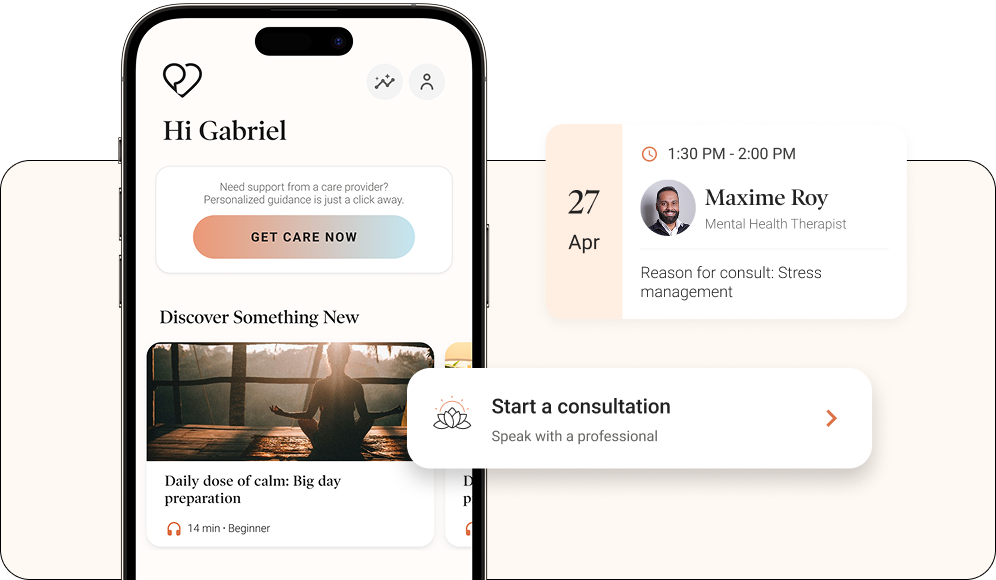
Dialogue consultation app - Preview of how to book an appointment consultaion-mobile-chat-image

See what Dialogue
could mean for your team.

Talk to one of our team members about how virtual mental health care can work for your organization — and what the ROI could look like at your scale.

Team discussion team-discussion-using-tablet
About the analysis

This cost-benefit analysis
was conducted by economists at AppEco on behalf of Dialogue.

The model focuses on common mental health disorders (depression, anxiety, and substance use) and is segmented by Canadian region (West, Ontario, Quebec, East) and industry. Costs and benefits are modelled from the perspectives of the public sector, private sector, and individuals. 
The virtual care scenario applies Dialogue's operations model, including its healthcare professionals allocation methodology, onboarding process, and care delivery approach.

AppEco

References

Ashwood J. Scott, Ateev Mehrotra, David Cowling and Lori Uscher-Pines (2017). Direct-To-Consumer Telehealth May Increase Access To Care But Does Not Decrease Spending. Health Affairs 36, no.3:485-49.

Canada Health Infoway (2022) Canadian Digital Health Survey. https://insights.infoway-inforoute.ca/2022-emental-health/.

Hafner, Marco, Yerushalmi, Erez, Dufresne, Eliane and Gkousis, Evangelos (2021). The potential socio-economic impact of telemedicine in Canada. RAND Europe.

Lerner D, Adler D, Hermann RC, Chang H, Ludman EJ, Greenhill A, Perch K, McPeck WC, Rogers WH (2012). Impact of a work-focused intervention on the productivity and symptoms of employees with depression. J Occup Environ Med. 54(2):128-35. doi: 10.1097/JOM.0b013e31824409d8. PMID: 22252528; PMCID: PMC3281506.

Patented Medicine Prices Review Board. (2025). Private Drug Plans in Canada: Expenditure Report, 2018–2023. Ottawa: PMPRB.

Statistics Canada (2023a). Mental disorders and access to mental health care. Catalogue no. 75-006-X, ISSN 2291-0840.

Statistics Canada (2023b) Work-related stress most often caused by heavy workloads and work-life balance.
Statistics Canada (2025) Virtual care use in Canada: Variation across sociodemographic and health-related factors.

Stewart WF, Ricci JA, Chee E, Hahn SR, Morganstein D. Cost of lost productive work time among US workers with depression. JAMA. 2003 Jun 18;289(23):3135-44. doi: 10.1001/jama.289.23.3135. Erratum in: JAMA. 2003 Oct 22;290(16):2218. PMID: 12813119.

Quick reference:

Key questions answered

Who is Dialogue, and what do they offer?

Dialogue is Canada’s premier virtual care platform that provides an employer-funded Mental Health+ program, among other health and wellness programs. Their model gives employees access to accredited mental health professionals (including therapists, psychologists, and social workers) virtually and on demand, removing the cost, wait time, and geographic barriers that prevent most Canadians from seeking care. Dialogue is accredited with Exemplary Standing by Accreditation Canada, the highest level of recognition available to healthcare organizations in the country.

What is the total cost of mental health challenges to Canadian employers?

Mental health challenges cost Canada $76 billion annually. Critically, 96% of that figure comes from lost productivity, not direct healthcare expenses. This breaks down into presenteeism (55%), where employees show up but operate below capacity, and absenteeism (41%), where employees miss work entirely. For a 500-person company, this translates to roughly 100 employees currently meeting diagnostic criteria for a mental health condition, many of them untreated and still attending work.

How much does untreated mental health cost per employee, per year?

Without virtual mental health care, the average employee costs an employer $2,170 per year in absenteeism and reduced productivity, regardless of whether that employee is currently experiencing mental health challenges. This figure reflects the average cost spread across an entire workforce, accounting for the fact that roughly 1 in 5 employees meet diagnostic criteria at any given time, and more than half of those receive no care.

What is presenteeism, and why does it cost more than absenteeism?

Presenteeism is when employees come to work but cannot perform at their full capacity due to well-being challenges, like poor mental health. It accounts for 55% of total mental health costs in Canada, because it is chronic, invisible, and never shows up in a benefits claim or absence record. Unlike absenteeism, it is rarely flagged or tracked, making it the highest and hardest-to-see cost for any organization.

What ROI can employers expect from virtual mental health care?

Canadian employers see an average 13x return on investment from Dialogue's virtual mental health care model. With virtual care in place, the per-employee cost of absenteeism and lost productivity drops from $2,170 to $1,535 annually. That $1,535 figure already includes the cost of the program itself. For a 500-person business, the net annual value recovered is approximately $317,500 ($635 per employee).

What happens when 10% more people get access to mental health care,
through appropriate employer-funded virtual care?

A 10% increase in access to appropriate mental health care reduces total mental health costs by 29%, unlocking $22 billion in annual savings at the national level. For individuals already in treatment, the efficiency gains are even greater: per-person costs drop by 53%, from $12,302 to $5,787, driven by fewer missed workdays, eliminated travel burden, and more effective provider matching. The average annual cost per person across all those in need falls from $11,859 to $8,390.

How does virtual mental health care reduce costs?

Virtual mental health care, like Dialogue, reduces employer costs through two distinct mechanisms. First, earlier intervention: when employees access care sooner, fewer reach the point of extended leave, burnout, or resignation, which represent the highest-cost outcomes for any organization. Second, better provider matching: virtual care reduces over-reliance on general practitioners (GPs) for mental health concerns, connecting employees to therapists, psychologists, or social workers who are better suited to their needs. This improves outcomes faster and avoids the cost of mismatched treatment.

Why are so many Canadians with mental health conditions going untreated?

51% of Canadians who meet the diagnostic criteria for a mental health condition receive no professional care. The main barriers are cost (high out-of-pocket expenses), long wait times (weeks to months for a first appointment), geographic access (particularly for rural populations), and a shortage of providers. Even those who do seek help often end up seeing a general practitioner (GP) for mental health concerns, when a psychologist, therapist, or social worker would be more appropriate and effective, adding cost and delay without improving outcomes.

How quickly can employees access virtual mental health
care through Dialogue?

Members can schedule an appointment within days through Dialogue, instead of weeks or months. Faster access enables earlier intervention, which prevents symptoms from escalating to the point of leave or resignation. Appointments are conducted virtually, so there is no travel time, and sessions fit within a 
standard workday.

Is the quality of care through Dialogue’s virtual mental health services
safe and credible?

Yes. Dialogue is accredited with Exemplary Standing by Accreditation Canada, the highest level of recognition available to healthcare organizations in the country. This accreditation is based on a review of over 700 criteria spanning clinical practices, governance, and patient safety standards. Dialogue's model also includes navigation to external specialists when needed, so complex cases receive appropriate support and gaps in care do not fall back on the employer or employee to manage.

What is a stepped mental health care model?

A stepped care model matches each person to the level of support that fits their needs — from self-guided digital resources, to therapist sessions, to specialist referrals — rather than defaulting everyone to the same intervention. This approach avoids both over-treatment (directing people to intensive support they don't need) and under-treatment (leaving people with insufficient support). The result is faster outcomes and lower per-person costs, since employees receive appropriate care without unnecessary escalation.

How does virtual care improve provider matching?

Many Canadians with mental health conditions end up seeing a general practitioner (GP) as their primary or only point of care, even when a psychologist, therapist, or social worker would be more appropriate. GPs are generalists, and while they can prescribe medication and provide referrals, they may not be the most effective match for conditions like depression, anxiety, or substance use disorders.

This mismatch adds cost and delay without improving outcomes. Dialogue's virtual platform uses triage to route each employee to the right type of provider from the start — whether that's a therapist for ongoing counselling, a social worker for situational support, or navigation to a specialist for complex cases. Better matching means faster recovery, fewer unnecessary interventions, and lower per-person costs. There’s an estimated 53% reduction in per-person costs for those already in treatment, driven in part by this provider matching efficiency.

What does the onboarding process look like for employers
who invest in Dialogue?

Dialogue's onboarding is designed to minimize the administrative burden on HR teams.
Key elements include fast activation so employees can access care from day one, a tailored engagement strategy to ensure employees are aware of and comfortable using the benefit, and ongoing support to monitor program utilization and address any barriers to access before they affect ROI. Dialogue works directly with each employer to build an approach that fits their specific workforce.